Italian Prisoner of War Camp (W20)
Over 1943 and 1944, the later years of World War II, Italians captured in various battles in North Africa were sent to Australia. Some found themselves at W20 in Jarrahdale.
Historical information
W20 was one of 28 prisoner of war (POW) camps in Westen Australia during WWII - the 'W' in the name stands for 'west'. It was built on the former site of Old 39 - a mill nicknamed as such because it was 39 miles from Rockingham, where WA timber would be shipped overseas.
The Jarrahdale site was regarded as a punishment camp for ‘delinquent’ POWs and had a population of 225 – 250. Lieutenant Tom Wesley Giblett, a stern disciplinarian, oversaw the camp until it closed in 1946.
Prisoners lived in 6-man ‘bell-type’ army tents, which were probably leftovers from World War I (some 20 years previous). To keep themselves and their clothes clean, the men would draw water from two wells in the camp to use at the ablution and laundry block. They did not bathe or wash in the creek as it was considered unhealthy and had leeches in it.
POWs were put to work cutting firewood, working in teams of up to 20 and using hand tools such as crosscut saws and axes. They would load the wood onto the trucks that would transport it elsewhere.
Although the men were paid for their labour*, they never received cash as it was illegal for POWs to have Australian currency in their possession. Instead, a ledger was kept to record credit and debit. Once a month an army canteen truck arrived, and the prisoners were able to ‘purchase’ small items such as cigarettes, socks and lollies. These were debited from their account.
*Prisoners of war were paid 1 schilling and sixpence for skilled labour like cutting firewood. Australian soldiers received 6 schillings for the same work.
Physical description
The camp sat alongside the 39 Mile Brook (also named after the mill) and close to the old railway line. The site is set amongst pine trees. Today, the remnants of the camp are the foundations of a pump house and ablution block, drainage system, the fireplace chimney of the mess hall and the entry to camp – marked by two tree trunks with a pole across the top.
Present day
This site is a profound reminder of the Second World War and its far-reaching effects. If you go on one of the Jarrahdale Guided Walks, this site will probably feature.
People of SJ
Lieutenant Tom Wesley Giblett
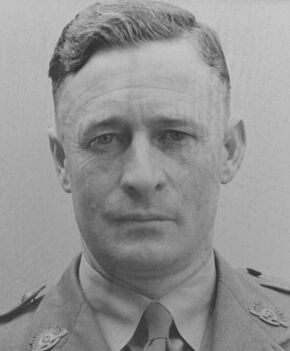
Lieutenant Giblett was born on 22 January 1900 in Greenbushes. When he was 17, he enlisted in the army to fight in WWI. Within a year he had joined the 3rd Division Signals Company in France, where he served until the end of the war. He returned to Australia in 1919 and was discharged.
WWII began in 1939. In 1940, 40-year-old Giblett, who had married and was working as a saw miller in Bridgetown, enlisted again. He was promoted to Lieutenant moved to Mt Hawthorn with his wife Irene Mary. For several years, Giblett served in various roles across the southern part of the state. In 1944 he was declared medically unfit for service outside Australia (likely due to a recurring double hernia) but suited to his present post as the commanding officer of another POW camp, W16.
While at W20 in 1946, he suffered a minor injury when a POW attacked him and Giblett fell, catching the blade of a circular saw with his right arm. The prisoner, a sailor named Emilio Formaro, was court martialled and found guilty on two of the three charges brought against him - failing to obey a lawful command and using violence against a superior officer. He was sentenced to two years’ detention in Fremantle Prison and forfeited 70 days’ pay.
Giblett’s service record notes a ‘disfigured’ little finger on his right hand and describe him as being 5 foot 10 inches, with a fair complexion, blue eyes and grey hair at the age of 45.
Giblett was voluntarily discharged in 1946 and became an accountant. In 1952, the veteran of two world wars was found dead by suicide in his car in West Perth. His wife, who was of similar age to her husband, died in 1958. They are both buried in Karrakatta Cemetery, but in different places – Tom in an Anglican plot, and Irene in a Catholic one.
Further reading and references
Special thanks to Mr Ernie Polis and Jarrahdale Heritage Society for aiding the research of this article.